Once upon a time- a long time ago, I worked for a company that tried to earn some extra money by moving their excess cash around before paying their bills.
So, the thought occured to me, that maybe some companies, try to shore up their share price by buying a large number of their own shares, you know, to stop day traders from mucking up the share price..
I don't know if that actually happens, but with so much volatility in the market, and having worked as an external auditor of systems, I sort of get that feeling...
I didn't want to, but I sold off some stuff today.
you know that feeling of reluctance. It's so hard to call it quits and give up on what you thought might prove a winner...
I owned some Sirrius once (ASX:SIR) and sold off too early...
and now I regret it.
But maybe it's better to take your money and run, and live to invest another day...
Who knows?
Remember we are not financial advisors..
Sampson management Services (SMS) educate and inform only...We are Assett Management Consultants- we teach you about risk and how to measure that risk according to the international standards on Quality, Environment, OHS, and Risk management in an integrated approach.
Ref standards:
AS/NZS/ISO 9001, AS/NZS/ISO 14001, AS/NZS/ISO 4804, AS/NZS/ISO 4360.
Megamoneybox address is http://Megamoneybox.blogspot.com.au We try to help you earn money on the internet.We give free share trading tips. We aim to educate and enthuse. We are in Australia in the land of the Sun. We are asset management and risk consultants, are not financial advisors. You Trade at your own risk. We could be wrong. So do your homework. Go to our other blogs to de stress. We are not big risk takers. We asses, investigate, analyse and then decide.
Showing posts with label yahoo finance pages. Show all posts
Showing posts with label yahoo finance pages. Show all posts
Thursday, October 9, 2014


Wednesday, July 6, 2011
CGT biggest gold seam ever discovered under Ballarat
announcement June 21 2011. Then 10 mins on 7.30 report last week.
ASX:CGT
But itnhasnt moved much.. here's hoping mid August or September sees a big find...
Castlemaine Goldfields hits big gold in Ballarat
BY FIONA HENDERSON
21 Jun, 2011 01:20 PM
CASTLEMAINE Goldfields has unearthed one of Ballarat’s best ever gold finds.
Exploration drilling at its $3 million Ballarat Gold Project — roughly 500 metres under the Barkly Street skate park — has unearthed a gold vein valued about $1400 per tonne.
Castlemaine Goldfields managing director Matt Gill said it was one of the greatest strikes he’d ever seen.
“This is one of the best underground gold intersections recorded to date in the Ballarat goldfield, and reinforces our conviction that the best area to explore and mine for gold at Ballarat is at the northern part of the goldfield,” Mr Gill said.
“We need more confirmation but it has raised our hopes, based on the geological data.”
The 29.1 metre long strike was found in the Sulieman Line in the project’s northern section, with 32.1 grams of gold found per tonne.
“Thirty grams is about one ounce and one ounce is worth about $1400. This is a very high value.
“To put it in perspective, the average grade of gold found in WA is two grams per tonne.
“We need to do more follow-up drilling and we need to do more intersections.”
Mr Gill said the find was not even in the Ballarat Gold Project’s current mine plan.
“We can now add it into our mine plan. It’s certainly made us think twice I can tell you.”
Castlemaine Goldfields bought Ballarat Goldfields in March last year for $4.5 million after it proved a liability for former owner Lihir Gold.
The company immediately concentrated on the mine’s northern sections, with initial assay results in July last year finding minerals much higher up the mine than expected.
Mr Gill said it was still planned to turn on the project’s gold mill in September, with an expected 50,000 ounces of gold to be extracted annually. “We are currently extending the existing underground decline and this will pass close by this intersection.
“We now plan to conduct in-fill drilling with the objective of being able to add this mineralisation into our near-term gold production plan.
“This represents a great upside for us, as we progress on schedule towards first gold production in September this year.”
About 100 workers are employed at the Ballarat Gold Project.
Remember we are not financial advisors.. Sampson management Services (SMS) educate and inform only...We are Assett Management Consultants- we teach you about risk and how to measure that risk according to the international standards on Quality, Environment, OHS, and Risk management in an integrated approach. Ref standards: AS/NZS/ISO 9001, AS/NZS/ISO 14001, AS/NZS/ISO 4804, AS/NZS/ISO 4360.
ASX:CGT
But itnhasnt moved much.. here's hoping mid August or September sees a big find...
Castlemaine Goldfields hits big gold in Ballarat
BY FIONA HENDERSON
21 Jun, 2011 01:20 PM
CASTLEMAINE Goldfields has unearthed one of Ballarat’s best ever gold finds.
Exploration drilling at its $3 million Ballarat Gold Project — roughly 500 metres under the Barkly Street skate park — has unearthed a gold vein valued about $1400 per tonne.
Castlemaine Goldfields managing director Matt Gill said it was one of the greatest strikes he’d ever seen.
“This is one of the best underground gold intersections recorded to date in the Ballarat goldfield, and reinforces our conviction that the best area to explore and mine for gold at Ballarat is at the northern part of the goldfield,” Mr Gill said.
“We need more confirmation but it has raised our hopes, based on the geological data.”
The 29.1 metre long strike was found in the Sulieman Line in the project’s northern section, with 32.1 grams of gold found per tonne.
“Thirty grams is about one ounce and one ounce is worth about $1400. This is a very high value.
“To put it in perspective, the average grade of gold found in WA is two grams per tonne.
“We need to do more follow-up drilling and we need to do more intersections.”
Mr Gill said the find was not even in the Ballarat Gold Project’s current mine plan.
“We can now add it into our mine plan. It’s certainly made us think twice I can tell you.”
Castlemaine Goldfields bought Ballarat Goldfields in March last year for $4.5 million after it proved a liability for former owner Lihir Gold.
The company immediately concentrated on the mine’s northern sections, with initial assay results in July last year finding minerals much higher up the mine than expected.
Mr Gill said it was still planned to turn on the project’s gold mill in September, with an expected 50,000 ounces of gold to be extracted annually. “We are currently extending the existing underground decline and this will pass close by this intersection.
“We now plan to conduct in-fill drilling with the objective of being able to add this mineralisation into our near-term gold production plan.
“This represents a great upside for us, as we progress on schedule towards first gold production in September this year.”
About 100 workers are employed at the Ballarat Gold Project.
Remember we are not financial advisors.. Sampson management Services (SMS) educate and inform only...We are Assett Management Consultants- we teach you about risk and how to measure that risk according to the international standards on Quality, Environment, OHS, and Risk management in an integrated approach. Ref standards: AS/NZS/ISO 9001, AS/NZS/ISO 14001, AS/NZS/ISO 4804, AS/NZS/ISO 4360.
Tuesday, July 5, 2011
TVN Corporation asx:TVN up from .017 to .030 in one week!
TVN Corporation asx:TVN up from .017 to .030 in one week!
bgt 30,000 on 28.6.11 profit so far 380.00 on a small 500.00 + 30 fees.
Worth a small investment..
Remember we are not financial advisors.. Sampson management Services (SMS) educate and inform only...We are Assett Management Consultants- we teach you about risk and how to measure that risk according to the international standards on Quality, Environment, OHS, and Risk management in an integrated approach. Ref standards: AS/NZS/ISO 9001, AS/NZS/ISO 14001, AS/NZS/ISO 4804, AS/NZS/ISO 4360.
bgt 30,000 on 28.6.11 profit so far 380.00 on a small 500.00 + 30 fees.
Worth a small investment..
Remember we are not financial advisors.. Sampson management Services (SMS) educate and inform only...We are Assett Management Consultants- we teach you about risk and how to measure that risk according to the international standards on Quality, Environment, OHS, and Risk management in an integrated approach. Ref standards: AS/NZS/ISO 9001, AS/NZS/ISO 14001, AS/NZS/ISO 4804, AS/NZS/ISO 4360.
Monday, June 21, 2010
so is this the answer? does China own us now?
Latest Commentary
from "the Business Speculator"
China's RSPT bounty
STEPHEN BARTHOLOMEUSZ The Rudd government's resource super profits tax will force miners to ask China's state-owned financiers for cash, bringing in more Chinese state-owned enterprises as shareholders. 4:13 PM read more
http://www.businessspectator.com.au/bs.nsf/Article/Bartholomeusz-RSPT-iron-ore-China-Development-Bank-pd20100621-6M8YT?OpenDocument&src=pmm
Commentary
4:13 PM, 21 Jun 2010
| More
Stephen Bartholomeusz
China's RSPT bounty
Kevin Rudd might want to characterise the $10 billion or so of deals with China unveiled today during the visit of Chinese vice-president Xi Jinping as evidence that the resource super profits tax is not affecting investment, but then the Chinese are not your ordinary investors.
And, indeed, given that China Development Bank (CDB) features in several of the resource deals signed today, the deals themselves aren’t necessarily conventional resource sector investments.
The Chinese might be a little annoyed that the RSPT was announced after their state-owned enterprises had invested tens of billions of dollars in the Australian resource sector but (a) their deals are likely to be the least affected by the RSPT (with a couple of exceptions) and (b) they aren’t necessarily as fixated with profitability as Australian miners.
It needs to be remembered that the Rudd government has hailed the tax – which would be paid largely by the big miners on well-established low-cost and highly profitable mines – as helping to promote hitherto marginal production within the sector. Its initial impact is positive for new and high-cost/low quality mines.
China is unlikely to be fussed if the big iron ore and metallurgical coal producers are less competitive, relative to their international peers, as a result of the tax, given the paranoia of its big steel producers about the level of influence and market power the producers have over key inputs into China’s industrial activity.
Conversely, it is in China’s own long-term interests to encourage new sources of iron ore and coal and other commodities to increase supply, temper price rises and counter the influence of the global resource groups.
Indeed, much of China’s activity in Australia in the past has been focused on the emerging iron ore producers like Fortescue and the Mid West iron ore province, which could be classified as marginal producers.
The memorandums of understanding China Development Bank has signed with Aquila Resources and Karara Mining – they both have West Australian iron ore projects in which there are pre-existing Chinese partners – fit the kind of strategy that is more interested in security of supply, increased supply and wider available sources of supply than in its absolute profitability.
Helping to finance the Oakajee port and rail infrastructure that helps open up the Mid West is a relatively obvious way for CDB to facilitate China’s strategic interests.
There is, potentially, enormous mutual interest in partnering with the Chinese to bring new projects and resource provinces into production.
That, however, doesn’t validate the proposed tax, which would amplify the strategic benefits the Chinese are seeking by slowing expansion of the production of our most efficient iron ore and coal producers – the ones able to use their market position to maximise the value received from exploiting those resources.
The other issue raised by the tax, and one that Fortescue’s Andrew Forrest has been particularly critical of, is that it will effectively destroy conventional project financing because the RSPT applies before financing costs.
To obtain project funding, smaller producers – who traditionally have used project financing to develop their mines – will have to turn to financiers more interested in gaining access to supply than in the security of their loans.
That almost inevitably means bringing in Chinese state-owned enterprises as shareholders and asking the Chinese state-owned financiers for help with the debt component. The impact of the RSPT would dictate that miners looked to financiers less interested in profitability than conventional capital providers.
One suspects that Rudd and Wayne Swan – both very sensitive to the politics of Chinese investment in the past – haven’t properly thought through the implications for Chinese interest in Australian resources of a RSPT that encourages marginal production during a boom, discourages conventional financing and commits the taxpayer to underwriting 40 per cent of the losses in a downturn.
Remember we are not financial advisors.. Sampson management Services (SMS) educate and inform only...We are Asset Management Consultants- we teach you about risk and how to measure that risk according to the international standards on Quality, Environment, OHS, and Risk management in an integrated approach. Ref standards:AS/NZS/ISO 9001, AS/NZS/ISO 14001, AS/NZS/ISO 4804, AS/NZS/ISO 4360.
from "the Business Speculator"
China's RSPT bounty
STEPHEN BARTHOLOMEUSZ The Rudd government's resource super profits tax will force miners to ask China's state-owned financiers for cash, bringing in more Chinese state-owned enterprises as shareholders. 4:13 PM read more
http://www.businessspectator.com.au/bs.nsf/Article/Bartholomeusz-RSPT-iron-ore-China-Development-Bank-pd20100621-6M8YT?OpenDocument&src=pmm
Commentary
4:13 PM, 21 Jun 2010
| More
Stephen Bartholomeusz
China's RSPT bounty
Kevin Rudd might want to characterise the $10 billion or so of deals with China unveiled today during the visit of Chinese vice-president Xi Jinping as evidence that the resource super profits tax is not affecting investment, but then the Chinese are not your ordinary investors.
And, indeed, given that China Development Bank (CDB) features in several of the resource deals signed today, the deals themselves aren’t necessarily conventional resource sector investments.
The Chinese might be a little annoyed that the RSPT was announced after their state-owned enterprises had invested tens of billions of dollars in the Australian resource sector but (a) their deals are likely to be the least affected by the RSPT (with a couple of exceptions) and (b) they aren’t necessarily as fixated with profitability as Australian miners.
It needs to be remembered that the Rudd government has hailed the tax – which would be paid largely by the big miners on well-established low-cost and highly profitable mines – as helping to promote hitherto marginal production within the sector. Its initial impact is positive for new and high-cost/low quality mines.
China is unlikely to be fussed if the big iron ore and metallurgical coal producers are less competitive, relative to their international peers, as a result of the tax, given the paranoia of its big steel producers about the level of influence and market power the producers have over key inputs into China’s industrial activity.
Conversely, it is in China’s own long-term interests to encourage new sources of iron ore and coal and other commodities to increase supply, temper price rises and counter the influence of the global resource groups.
Indeed, much of China’s activity in Australia in the past has been focused on the emerging iron ore producers like Fortescue and the Mid West iron ore province, which could be classified as marginal producers.
The memorandums of understanding China Development Bank has signed with Aquila Resources and Karara Mining – they both have West Australian iron ore projects in which there are pre-existing Chinese partners – fit the kind of strategy that is more interested in security of supply, increased supply and wider available sources of supply than in its absolute profitability.
Helping to finance the Oakajee port and rail infrastructure that helps open up the Mid West is a relatively obvious way for CDB to facilitate China’s strategic interests.
There is, potentially, enormous mutual interest in partnering with the Chinese to bring new projects and resource provinces into production.
That, however, doesn’t validate the proposed tax, which would amplify the strategic benefits the Chinese are seeking by slowing expansion of the production of our most efficient iron ore and coal producers – the ones able to use their market position to maximise the value received from exploiting those resources.
The other issue raised by the tax, and one that Fortescue’s Andrew Forrest has been particularly critical of, is that it will effectively destroy conventional project financing because the RSPT applies before financing costs.
To obtain project funding, smaller producers – who traditionally have used project financing to develop their mines – will have to turn to financiers more interested in gaining access to supply than in the security of their loans.
That almost inevitably means bringing in Chinese state-owned enterprises as shareholders and asking the Chinese state-owned financiers for help with the debt component. The impact of the RSPT would dictate that miners looked to financiers less interested in profitability than conventional capital providers.
One suspects that Rudd and Wayne Swan – both very sensitive to the politics of Chinese investment in the past – haven’t properly thought through the implications for Chinese interest in Australian resources of a RSPT that encourages marginal production during a boom, discourages conventional financing and commits the taxpayer to underwriting 40 per cent of the losses in a downturn.
Remember we are not financial advisors.. Sampson management Services (SMS) educate and inform only...We are Asset Management Consultants- we teach you about risk and how to measure that risk according to the international standards on Quality, Environment, OHS, and Risk management in an integrated approach. Ref standards:AS/NZS/ISO 9001, AS/NZS/ISO 14001, AS/NZS/ISO 4804, AS/NZS/ISO 4360.
Sunday, June 13, 2010
The bigger picture!
. Rudd announces Chemists supertax! we might need to tax the foreign companies who have made deals with aboriginal groups, and who are not on the asx, but to become a joint partner and subsidise losses via the taxpayer is ridiculous. To tax a company 40% above the bond rate (say 6%)is socialism.
There's been no legislation put up, no real discussion and what industry will be next?
Mega from http://noresourcetax.blogspot.com says Beware for our future. Why not a chemist supertax? they make money from already taxpayer funded doctors prescriptions.. or pathologists..they make money from taxpayers and bleed govt dry! Rudd imposed a RSPT while reducing company tax from 30% to 28%? He gives in one hand, takes away in the other..
Remember we are not financial advisors.. Sampson management Services (SMS) educate and inform only...We are Asset Management Consultants- we teach you about risk and how to measure that risk according to the international standards on Quality, Environment, OHS, and Risk management in an integrated approach. Ref standards:AS/NZS/ISO 9001, AS/NZS/ISO 14001, AS/NZS/ISO 4804, AS/NZS/ISO 4360.
There's been no legislation put up, no real discussion and what industry will be next?
Mega from http://noresourcetax.blogspot.com says Beware for our future. Why not a chemist supertax? they make money from already taxpayer funded doctors prescriptions.. or pathologists..they make money from taxpayers and bleed govt dry! Rudd imposed a RSPT while reducing company tax from 30% to 28%? He gives in one hand, takes away in the other..
Remember we are not financial advisors.. Sampson management Services (SMS) educate and inform only...We are Asset Management Consultants- we teach you about risk and how to measure that risk according to the international standards on Quality, Environment, OHS, and Risk management in an integrated approach. Ref standards:AS/NZS/ISO 9001, AS/NZS/ISO 14001, AS/NZS/ISO 4804, AS/NZS/ISO 4360.
Monday, June 7, 2010
free tips
free aussie sharemarke tip for today. follow carzyjimsmith on twitter
#asx CAP still going strong! 38c
14 minutes ago via web
Remember we are not financial advisors.. Sampson management Services (SMS) educate and inform only...We are Asset Management Consultants- we teach you about risk and how to measure that risk according to the international standards on Quality, Environment, OHS, and Risk management in an integrated approach. Ref standards:AS/NZS/ISO 9001, AS/NZS/ISO 14001, AS/NZS/ISO 4804, AS/NZS/ISO 4360.
#asx CAP still going strong! 38c
14 minutes ago via web
Remember we are not financial advisors.. Sampson management Services (SMS) educate and inform only...We are Asset Management Consultants- we teach you about risk and how to measure that risk according to the international standards on Quality, Environment, OHS, and Risk management in an integrated approach. Ref standards:AS/NZS/ISO 9001, AS/NZS/ISO 14001, AS/NZS/ISO 4804, AS/NZS/ISO 4360.
Friday, June 4, 2010
the Future fund view
Mega's view is that govt should scrap it and find another way to raise revenues to fix gaping hole in budget. Like add 1% to the GST. That would be acceptable to most people,especially if it was to be for a limited time.
..http://keepminingstrong.posterous.com/rss.xml
Today, June 04, 2010, 3 hours ago
The Future Fund was established to assist Australian governments meet the cost of public sector superannuation liabilities by delivering investment returns on contributions to the Fund.
You can watch the video of the interview here, or read our transcript below.
--
Alan Kohler: Well David, perhaps we can start by asking you your view of the RSPT, the resource super profits tax?
David Murray: You’re probably aware that I made an address at the Australian Papua New Guinea (PNG) Conference in Townsville recently because PNG is going through the process of designing a wealth fund to deal with its oil and gas dividends, taxes and royalties and trying to determine how much should be spent today, essentially, and how much put aside for tomorrow. And you know going through that issue in the context of PNG really makes one consider the pros and cons of this tax regime in Australia. I think the discussion has to be divided into two parts. One is the application of the tax to existing projects and the sovereign risk concerns that the tax brings for Australia, and secondly the design of the tax around the Australian Constitution and the source and flow of funds, whether they’re used for long- term purposes or short-term purposes.
Stephen Bartholomeusz: David, there’s a presumption there that there should be a super tax on mining profits.
DM: No, not necessarily. You’ve got to remember in Australia that states own their land, the resources under the land and have the right to collect royalties on those resources. The Commonwealth has the taxing power and has ownership of its territories and resources outside the coastline. But the Commonwealth has already imposed royalties and the Petroleum Resource Rent Tax (PRRT). The issue here is that the states are not in a very good position to set aside their royalties for longer-term purposes. If the Commonwealth wants to impose a super profits tax on resources activity, then the Commonwealth has to think about when and how that’s used. But that’s why I divide the whole issue into retrospectivity or application to existing projects, on one hand, and the design on the other.
AK: Isn’t there possibly a third element, which is the way that the proposed tax reduces the net present value of future projects because all of the mining companies are now saying that they’re not going to go ahead, or they’re putting future projects on hold, or that there’ll be fewer projects and they’ll be looking at other countries instead of Australia?
DM: Well, the consequence of additional tax is magnified across returns and, you know, that's what they say is technically correct. But the design of this tax has had to be customised to a particular application because of the constitutional position and, in doing that, there are several significant flaws. My view is that the tax has to be changed or abandoned.
AK: Which would you prefer, the change or the abandonment?
DM: Well, it’s conditional. If there’s a change, there has to be some process of putting aside returns from resources depletion for the longer term – and that doesn’t happen in the states and it’s not really happening at the Commonwealth level – and unless we do that, we’ll be directing resource taxes of one sort or another to recurrent spending of government, which will actually cause significant problems later because all resources go through waves of strong returns and weak returns and you’ve got to have a sensible collection of taxes and royalties when returns are strong, but you can’t apply these retrospectively because you won’t get investment.
SB: So, David, what you’re saying is if you’re going to have this kind of tax, the revenue should go into the future fund or a fund like it.
DM: Well, you can do it in a couple of ways.You can dedicate a part of royalties to go into long-term wealth funds, intergenerational funds, or you can direct budget surpluses when the terms of trade are strong and the budget is strong. But in Australia’s case, you’ve got to give some consideration to what happens in the states. If states collect royalties, there should be some incentive to put some of that aside and the reason for that is that it can’t happen as easily elsewhere. For example, the states should not be penalised on their grants from the Commonwealth if they collect significant mining royalties.
AK: Well, the reality is that this sort of revenue will go at least to some extent into recurrent expenditures, so in that case are you saying that this proposal ought to just be abandoned?
DM: Well, if we can’t achieve a design that does not penalise the existing projects – that’s a sovereign risk issue and a design that does not discriminate between recurrent spending and long-term intergenerational wealth creation; if those things can’t be done, the tax should be abandoned.
AK: Right. So, just to be clear on it, you’re saying that it should not apply to existing projects, only future projects and that all the revenue should go into a fund for the future.
DM: No, not all the revenue, but there should be some sensible calculation and debate about what portion of compensation for resource depletion goes into recurrent spending in Australia in total and goes into intergenerational wealth creation.
SB: David, the tax, as it stands, one of its several design features is this 40 per cent credit. You were a banker for decades; if a miner came to you and said will you lend against this IOU from the government, would you do it?
DM: Well, I would be more concerned about that now because of what’s happened with the announcement of this tax. When mining companies go to less developed countries with a poor track record of rule of law and taxation, they generally seek tax standstill arrangements, commitments from government and they also get an acknowledgement of those standstill arrangements from political parties not in government. Traditionally that’s not been regarded as necessary in Australia and I think mining companies, and companies generally, understand that the general rate of company tax can move over time, but it’s the specially structured designer taxes that give rise to additional sovereign risk.
Australia has a good track record on sovereign risk, but if I could just go on a fraction more, Steve, the issue here is that for investors globally, sovereign risk is coming back into the picture as a larger issue because of the massive issuance of sovereign debt around the world post crisis – not just post, but before the crisis and especially during and after. As a consequence of that, investors are becoming a little bit concerned whether governments will become more desperate and impose things that might… that they might not otherwise have done. So, for Australia to do this now is not good timing and if I was a mining company I’d be extremely concerned that tax is being taken off at the top of the cycle. The best thing for Australia to do is to take a component of its corporate taxes that can be attributed to resource depletion and set it aside.
AK: In fact you seem to be suggesting that to some extent the tax is self defeating in that it requires a level of sovereign trust from, in particular, financiers, but the way that it has been introduced actually destroys that trust.
DM: Well, yes, I think it does. And in addition to that, our starting point is a country that needs foreign investment and, notwithstanding all of our success, we still have a current account deficit, you know, and a chronic current account deficit, and that has to end at some time in our history. The worst thing that can happen is that the resources run down, we’re still spending on welfare and we still have a current account deficit. That would be, for future generations, a seriously bad outcome.
AK: So, is the extra sovereign risk that has clearly been identified by other investors around the world, is that affecting or likely to affect the future fund’s asset allocation. You’ve got quite a large allocation to international equities at the moment, in both developed and developing economies, but is that likely to increase at the expense of Australia, given this?
DM: Well, actually the large allocation is not offshore.The large allocation to equities is onshore if you consider the relative scale of Australia’s economy to others, and the reason for that is partly because we have less exchange risk onshore, but partly because we see Australia as a proxy for Asia, including China and India, and their growth. If that proxy principle breaks down, then we would not see as much of a reason to be invested in Australia.
SB: David, if there has to be a tax, do you have a particular design in mind that would be reasonable?
DM: Well, we need a design for new projects starting from exploration up and the one that’s understood is the PRRT. So, in my view, that would be a better structure, but it could not apply to any existing projects or any existing exploration. Bear in mind that the design of this tax makes the Australian taxpayer a mining joint venture and, as a taxpayer, if I am a joint venture in a mine, I’d really want my joint venture partner to be well-resourced enough financially and, in skill terms, to do a good job with the mine. If they are taxed on a basis that does not enable them to do that, then I carry all of the risk of the investment of my tax money and much less upside because if my joint venture partner is not incentivised, then I’m less likely to get the returns. So, I’m not sure if that answered your question directly, but you know when you have to make a designer tax partly for constitutional reasons and partly for current funding, then you get into all sorts of difficulties.
SB: Another design feature of the tax is that it cuts in before the financing costs. A lot of smaller mines in Australia have been project financed. What would be the implications of an RSPT be for project financing in this market?
DM: Well, as you pointed out before, you’re absolutely dependent on the cash flowing from the government and it’s not clear that that will always be the case, especially with the terms of trade and commodity prices. If that changes, then the Australian revenue has got a flow of commitments for existing projects and virtually none of the super profits tax. So the current account cycle would actually deteriorate.
AK: David, there’s now a pretty fiery barney going on between the government and the mining industry. There’s lots of name calling, the government’s now launched a taxpayer-funded advertising campaign against them, how do you feel about that and are you concerned about the consequences of that?
DM: Yes I am. This should be the subject of sensible negotiation behind the scenes. One implication of this advertising war is that a lot of foreign investors see Australia as a place where common sense usually prevails and this sort of public brawl will reduce their confidence in those sorts of things happening. And the difference between us and a lot of countries, with resources, is that we had this reliability; we’ve had a solid rule of law and we’ve had a taxation regime which has been highly predictable.
SB: David, the revenues from this tax, if it were implemented, are designed to bring the budget back into balance three years ahead of the previous schedule. Is that a priority and does it validate the tax?
DM: I think it’s more the implications of the tax. It doesn’t validate it if the tax itself is going to cause you to collect less in the long run, and that’s possible. So, I think that the budgetary issues have got more to do with whether we want loose or easy fiscal policy, in the context of what’s happening with monetary policy, and particularly the household sector indebtedness in Australia. So it only takes very small doses of monetary policy to have a significant effect on consumption and so the budget should be framed in that light. So I think you’ve got to weigh those things up in framing the budget, Steve.
SB: But does it matter that much whether it’s in surplus in three years or four years?
DM: Well, it depends on how you do it and the problem with this tax is it could cause more trouble. It’s a long-term tax being applied to a short-term purpose, really, and that’s where the problems arise.
AK: We’ll have to leave it there. Thanks very much, David.
DM: Thanks, guys.
SB: Thank you, David.
DM: Thank you.
Remember we are not financial advisors.. Sampson management Services (SMS) educate and inform only...We are Asset Management Consultants- we teach you about risk and how to measure that risk according to the international standards on Quality, Environment, OHS, and Risk management in an integrated approach. Ref standards:AS/NZS/ISO 9001, AS/NZS/ISO 14001, AS/NZS/ISO 4804, AS/NZS/ISO 4360.
..http://keepminingstrong.posterous.com/rss.xml
Today, June 04, 2010, 3 hours ago
The Future Fund was established to assist Australian governments meet the cost of public sector superannuation liabilities by delivering investment returns on contributions to the Fund.
You can watch the video of the interview here, or read our transcript below.
--
Alan Kohler: Well David, perhaps we can start by asking you your view of the RSPT, the resource super profits tax?
David Murray: You’re probably aware that I made an address at the Australian Papua New Guinea (PNG) Conference in Townsville recently because PNG is going through the process of designing a wealth fund to deal with its oil and gas dividends, taxes and royalties and trying to determine how much should be spent today, essentially, and how much put aside for tomorrow. And you know going through that issue in the context of PNG really makes one consider the pros and cons of this tax regime in Australia. I think the discussion has to be divided into two parts. One is the application of the tax to existing projects and the sovereign risk concerns that the tax brings for Australia, and secondly the design of the tax around the Australian Constitution and the source and flow of funds, whether they’re used for long- term purposes or short-term purposes.
Stephen Bartholomeusz: David, there’s a presumption there that there should be a super tax on mining profits.
DM: No, not necessarily. You’ve got to remember in Australia that states own their land, the resources under the land and have the right to collect royalties on those resources. The Commonwealth has the taxing power and has ownership of its territories and resources outside the coastline. But the Commonwealth has already imposed royalties and the Petroleum Resource Rent Tax (PRRT). The issue here is that the states are not in a very good position to set aside their royalties for longer-term purposes. If the Commonwealth wants to impose a super profits tax on resources activity, then the Commonwealth has to think about when and how that’s used. But that’s why I divide the whole issue into retrospectivity or application to existing projects, on one hand, and the design on the other.
AK: Isn’t there possibly a third element, which is the way that the proposed tax reduces the net present value of future projects because all of the mining companies are now saying that they’re not going to go ahead, or they’re putting future projects on hold, or that there’ll be fewer projects and they’ll be looking at other countries instead of Australia?
DM: Well, the consequence of additional tax is magnified across returns and, you know, that's what they say is technically correct. But the design of this tax has had to be customised to a particular application because of the constitutional position and, in doing that, there are several significant flaws. My view is that the tax has to be changed or abandoned.
AK: Which would you prefer, the change or the abandonment?
DM: Well, it’s conditional. If there’s a change, there has to be some process of putting aside returns from resources depletion for the longer term – and that doesn’t happen in the states and it’s not really happening at the Commonwealth level – and unless we do that, we’ll be directing resource taxes of one sort or another to recurrent spending of government, which will actually cause significant problems later because all resources go through waves of strong returns and weak returns and you’ve got to have a sensible collection of taxes and royalties when returns are strong, but you can’t apply these retrospectively because you won’t get investment.
SB: So, David, what you’re saying is if you’re going to have this kind of tax, the revenue should go into the future fund or a fund like it.
DM: Well, you can do it in a couple of ways.You can dedicate a part of royalties to go into long-term wealth funds, intergenerational funds, or you can direct budget surpluses when the terms of trade are strong and the budget is strong. But in Australia’s case, you’ve got to give some consideration to what happens in the states. If states collect royalties, there should be some incentive to put some of that aside and the reason for that is that it can’t happen as easily elsewhere. For example, the states should not be penalised on their grants from the Commonwealth if they collect significant mining royalties.
AK: Well, the reality is that this sort of revenue will go at least to some extent into recurrent expenditures, so in that case are you saying that this proposal ought to just be abandoned?
DM: Well, if we can’t achieve a design that does not penalise the existing projects – that’s a sovereign risk issue and a design that does not discriminate between recurrent spending and long-term intergenerational wealth creation; if those things can’t be done, the tax should be abandoned.
AK: Right. So, just to be clear on it, you’re saying that it should not apply to existing projects, only future projects and that all the revenue should go into a fund for the future.
DM: No, not all the revenue, but there should be some sensible calculation and debate about what portion of compensation for resource depletion goes into recurrent spending in Australia in total and goes into intergenerational wealth creation.
SB: David, the tax, as it stands, one of its several design features is this 40 per cent credit. You were a banker for decades; if a miner came to you and said will you lend against this IOU from the government, would you do it?
DM: Well, I would be more concerned about that now because of what’s happened with the announcement of this tax. When mining companies go to less developed countries with a poor track record of rule of law and taxation, they generally seek tax standstill arrangements, commitments from government and they also get an acknowledgement of those standstill arrangements from political parties not in government. Traditionally that’s not been regarded as necessary in Australia and I think mining companies, and companies generally, understand that the general rate of company tax can move over time, but it’s the specially structured designer taxes that give rise to additional sovereign risk.
Australia has a good track record on sovereign risk, but if I could just go on a fraction more, Steve, the issue here is that for investors globally, sovereign risk is coming back into the picture as a larger issue because of the massive issuance of sovereign debt around the world post crisis – not just post, but before the crisis and especially during and after. As a consequence of that, investors are becoming a little bit concerned whether governments will become more desperate and impose things that might… that they might not otherwise have done. So, for Australia to do this now is not good timing and if I was a mining company I’d be extremely concerned that tax is being taken off at the top of the cycle. The best thing for Australia to do is to take a component of its corporate taxes that can be attributed to resource depletion and set it aside.
AK: In fact you seem to be suggesting that to some extent the tax is self defeating in that it requires a level of sovereign trust from, in particular, financiers, but the way that it has been introduced actually destroys that trust.
DM: Well, yes, I think it does. And in addition to that, our starting point is a country that needs foreign investment and, notwithstanding all of our success, we still have a current account deficit, you know, and a chronic current account deficit, and that has to end at some time in our history. The worst thing that can happen is that the resources run down, we’re still spending on welfare and we still have a current account deficit. That would be, for future generations, a seriously bad outcome.
AK: So, is the extra sovereign risk that has clearly been identified by other investors around the world, is that affecting or likely to affect the future fund’s asset allocation. You’ve got quite a large allocation to international equities at the moment, in both developed and developing economies, but is that likely to increase at the expense of Australia, given this?
DM: Well, actually the large allocation is not offshore.The large allocation to equities is onshore if you consider the relative scale of Australia’s economy to others, and the reason for that is partly because we have less exchange risk onshore, but partly because we see Australia as a proxy for Asia, including China and India, and their growth. If that proxy principle breaks down, then we would not see as much of a reason to be invested in Australia.
SB: David, if there has to be a tax, do you have a particular design in mind that would be reasonable?
DM: Well, we need a design for new projects starting from exploration up and the one that’s understood is the PRRT. So, in my view, that would be a better structure, but it could not apply to any existing projects or any existing exploration. Bear in mind that the design of this tax makes the Australian taxpayer a mining joint venture and, as a taxpayer, if I am a joint venture in a mine, I’d really want my joint venture partner to be well-resourced enough financially and, in skill terms, to do a good job with the mine. If they are taxed on a basis that does not enable them to do that, then I carry all of the risk of the investment of my tax money and much less upside because if my joint venture partner is not incentivised, then I’m less likely to get the returns. So, I’m not sure if that answered your question directly, but you know when you have to make a designer tax partly for constitutional reasons and partly for current funding, then you get into all sorts of difficulties.
SB: Another design feature of the tax is that it cuts in before the financing costs. A lot of smaller mines in Australia have been project financed. What would be the implications of an RSPT be for project financing in this market?
DM: Well, as you pointed out before, you’re absolutely dependent on the cash flowing from the government and it’s not clear that that will always be the case, especially with the terms of trade and commodity prices. If that changes, then the Australian revenue has got a flow of commitments for existing projects and virtually none of the super profits tax. So the current account cycle would actually deteriorate.
AK: David, there’s now a pretty fiery barney going on between the government and the mining industry. There’s lots of name calling, the government’s now launched a taxpayer-funded advertising campaign against them, how do you feel about that and are you concerned about the consequences of that?
DM: Yes I am. This should be the subject of sensible negotiation behind the scenes. One implication of this advertising war is that a lot of foreign investors see Australia as a place where common sense usually prevails and this sort of public brawl will reduce their confidence in those sorts of things happening. And the difference between us and a lot of countries, with resources, is that we had this reliability; we’ve had a solid rule of law and we’ve had a taxation regime which has been highly predictable.
SB: David, the revenues from this tax, if it were implemented, are designed to bring the budget back into balance three years ahead of the previous schedule. Is that a priority and does it validate the tax?
DM: I think it’s more the implications of the tax. It doesn’t validate it if the tax itself is going to cause you to collect less in the long run, and that’s possible. So, I think that the budgetary issues have got more to do with whether we want loose or easy fiscal policy, in the context of what’s happening with monetary policy, and particularly the household sector indebtedness in Australia. So it only takes very small doses of monetary policy to have a significant effect on consumption and so the budget should be framed in that light. So I think you’ve got to weigh those things up in framing the budget, Steve.
SB: But does it matter that much whether it’s in surplus in three years or four years?
DM: Well, it depends on how you do it and the problem with this tax is it could cause more trouble. It’s a long-term tax being applied to a short-term purpose, really, and that’s where the problems arise.
AK: We’ll have to leave it there. Thanks very much, David.
DM: Thanks, guys.
SB: Thank you, David.
DM: Thank you.
Remember we are not financial advisors.. Sampson management Services (SMS) educate and inform only...We are Asset Management Consultants- we teach you about risk and how to measure that risk according to the international standards on Quality, Environment, OHS, and Risk management in an integrated approach. Ref standards:AS/NZS/ISO 9001, AS/NZS/ISO 14001, AS/NZS/ISO 4804, AS/NZS/ISO 4360.
Friday, May 28, 2010
About the mining resource supertax
Date/Time: 2010:05:27 02:04:58 Source: The Australian
THE Rudd government is moving towards a major backdown on its $12 billion tax on resources, redefining its proposed super-profits levy, but the big mining companies have declared the changes do not stop the risk to investment in Australia.
Only three weeks after unveiling the new resource super-profits tax, the government is preparing to lift the threshold definition of a super profit from 6 per cent to 11 or 12 per cent following a ferocious campaign by the mining companies.
To offset the lost revenue in raising the threshold to the same level as the existing petroleum resources rent tax, which applies to offshore gasfields, the government intends to withdraw the 40 per cent taxpayer-funded compensation originally offered for mining projects that fail.
But all the major mining companies have rejected the new proposals as "tinkering at the edges" and not addressing the main risk to mining investment in Australia. The mining companies are demanding more negotiation with the government on the issues of the retrospective application of the new tax, different rates for different minerals and the 40 per cent tax rate.
Start of sidebar. Skip to end of sidebar.
Related Coverage
DU PLESSIS: Rio boss returns fire at Swan
OFFICIAL: Outcry only scaring investors
RICH LIST: Mining magnates dig in
DENNIS SHANAHAN: Judges give Rudd a big zero
DESPATCH BOX: And then Papa Bear said...
VIDEO: Resources tax minefield
IN DEPTH: Henry Tax Review
Mining tax won't raise prices - Henry Daily Telegraph, 11 hours ago
$27bn ore exports at risk The Australian, 20 hours ago
Treasury boss defends mine tax Herald Sun, 1 day ago
Good policy the winner as Labor rethinks its tax The Australian, 1 day ago
Miners paid extra in boom time Perth Now, 2 days ago
End of sidebar. Return to start of sidebar.
BHP Billiton chief executive Marius Kloppers declared last night that any thought the petroleum tax would work for minerals was "naive" and demonstrated "a lack of knowledge as to how investments are made".
"Most importantly, we must understand that for each mineral we are competing against other investment destinations, and each set of minerals has a different set of competitors and those competitors set the price," Mr Kloppers told The Australian.
And Xstrata chief executive Mick Davis said from South Africa: "The government needs to do what it should have done all along and enter into full and open consultations with the industry where every aspect of the super tax is open for debate. Tinkering at the margins will not avoid the significant long-term damage this tax could do to mining investment in Australia.
"The government should stop negotiating with itself and start consulting with the industry."
Rio Tinto chairman Jan du Plessis told the company's shareholders that Australia's reputation had already been damaged by the super-profits tax proposal.
"We are concerned that the proposed resources super tax will erode Australia's competitiveness, severely curtail investment and limit jobs growth," Mr du Plessis said yesterday. He said that some of the government's arguments for the tax and some of the statistics that had been produced to support them "could only be described as scandalous, totally scandalous".
Wayne Swan continued his criticisms of the mining companies yesterday, telling parliament they were still paying only 17c in the dollar in tax compared with the "headline rate" of 30 per cent. The Treasurer vowed to keep the 40 per cent rate for the new RSPT.
"What we have to do is extract the maximum value for the Australian people as we go forward to reform our economy, to invest in our economy and to ensure our prosperity as we go forward," Mr Swan said.
Earlier, he said the government was "interested and fair dinkum about consultation".
"The government is involved in consultation," Mr Swan said. "First of all, we have our consultation panel. Over 80 companies have been through that panel process and are talking to that panel. In addition to that, the government is continuing to talk to many mining companies about their views.
"What we are going to get for the Australian people is a fair share of the resources they own 100 per cent, a fair share - a tax which encourages investment and growth in the industry."
The government's consultation panel, headed by Treasury deputy secretary David Parker, will give its first report to the government tomorrow. It is expected to go beyond its strict limits for discussion and recommend the raising of the threshold for the super-profits tax to be lifted from 6 per cent, the long-term government bond rate, to about 11 or 12 per cent, the bond rate plus five or six percentage points.
As reported in The Australian on Monday, the lost revenue would be covered by the withdrawal of the 40 per cent compensation for failed projects to enable the government to keep its budget projections, including a $1bn surplus in 2012-13, intact.
Mr Parker said yesterday the proposed RSPT as a result of the Henry tax review was "the architecture of reform, not the engineering drawings".
"With such reforms, there will always be winners and losers, with some groups more vocal than others," Mr Parker said. "The challenge is to work together to address the issues that will inevitably arise."
Government sources confirmed that the panel was expected to recommend major changes to the proposed RSPT, including raising the threshold, but others warned it was unlikely there would be an early settlement of the negotiations with the mining companies.
In Adelaide, Mr Kloppers said a 40 per cent tax rate may have been considered appropriate when it was devised for the petroleum industry in the 1980s after two years of consultation but it was "a giant, naive extrapolation to think miraculously the same one is the appropriate rate for every mineral in 2010".
"BHP Billiton, being in the oil and gas industry and in the minerals industry, has experience on both sides and, more than other players, we understand the difference between the products themselves and between minerals more broadly," he said.
"Retrospectivity on this tax is the key determinant for Australia as a destination for investment.
"It goes against the core offering that Australia has, which is being a stable place for investment."
67 comments on this story
Remember we are not financial advisors.. Sampson management Services (SMS) educate and inform only...We are Asset Management Consultants- we teach you about risk and how to measure that risk according to the international standards on Quality, Environment, OHS, and Risk management in an integrated approach. Ref standards:AS/NZS/ISO 9001, AS/NZS/ISO 14001, AS/NZS/ISO 4804, AS/NZS/ISO 4360.
THE Rudd government is moving towards a major backdown on its $12 billion tax on resources, redefining its proposed super-profits levy, but the big mining companies have declared the changes do not stop the risk to investment in Australia.
Only three weeks after unveiling the new resource super-profits tax, the government is preparing to lift the threshold definition of a super profit from 6 per cent to 11 or 12 per cent following a ferocious campaign by the mining companies.
To offset the lost revenue in raising the threshold to the same level as the existing petroleum resources rent tax, which applies to offshore gasfields, the government intends to withdraw the 40 per cent taxpayer-funded compensation originally offered for mining projects that fail.
But all the major mining companies have rejected the new proposals as "tinkering at the edges" and not addressing the main risk to mining investment in Australia. The mining companies are demanding more negotiation with the government on the issues of the retrospective application of the new tax, different rates for different minerals and the 40 per cent tax rate.
Start of sidebar. Skip to end of sidebar.
Related Coverage
DU PLESSIS: Rio boss returns fire at Swan
OFFICIAL: Outcry only scaring investors
RICH LIST: Mining magnates dig in
DENNIS SHANAHAN: Judges give Rudd a big zero
DESPATCH BOX: And then Papa Bear said...
VIDEO: Resources tax minefield
IN DEPTH: Henry Tax Review
Mining tax won't raise prices - Henry Daily Telegraph, 11 hours ago
$27bn ore exports at risk The Australian, 20 hours ago
Treasury boss defends mine tax Herald Sun, 1 day ago
Good policy the winner as Labor rethinks its tax The Australian, 1 day ago
Miners paid extra in boom time Perth Now, 2 days ago
End of sidebar. Return to start of sidebar.
BHP Billiton chief executive Marius Kloppers declared last night that any thought the petroleum tax would work for minerals was "naive" and demonstrated "a lack of knowledge as to how investments are made".
"Most importantly, we must understand that for each mineral we are competing against other investment destinations, and each set of minerals has a different set of competitors and those competitors set the price," Mr Kloppers told The Australian.
And Xstrata chief executive Mick Davis said from South Africa: "The government needs to do what it should have done all along and enter into full and open consultations with the industry where every aspect of the super tax is open for debate. Tinkering at the margins will not avoid the significant long-term damage this tax could do to mining investment in Australia.
"The government should stop negotiating with itself and start consulting with the industry."
Rio Tinto chairman Jan du Plessis told the company's shareholders that Australia's reputation had already been damaged by the super-profits tax proposal.
"We are concerned that the proposed resources super tax will erode Australia's competitiveness, severely curtail investment and limit jobs growth," Mr du Plessis said yesterday. He said that some of the government's arguments for the tax and some of the statistics that had been produced to support them "could only be described as scandalous, totally scandalous".
Wayne Swan continued his criticisms of the mining companies yesterday, telling parliament they were still paying only 17c in the dollar in tax compared with the "headline rate" of 30 per cent. The Treasurer vowed to keep the 40 per cent rate for the new RSPT.
"What we have to do is extract the maximum value for the Australian people as we go forward to reform our economy, to invest in our economy and to ensure our prosperity as we go forward," Mr Swan said.
Earlier, he said the government was "interested and fair dinkum about consultation".
"The government is involved in consultation," Mr Swan said. "First of all, we have our consultation panel. Over 80 companies have been through that panel process and are talking to that panel. In addition to that, the government is continuing to talk to many mining companies about their views.
"What we are going to get for the Australian people is a fair share of the resources they own 100 per cent, a fair share - a tax which encourages investment and growth in the industry."
The government's consultation panel, headed by Treasury deputy secretary David Parker, will give its first report to the government tomorrow. It is expected to go beyond its strict limits for discussion and recommend the raising of the threshold for the super-profits tax to be lifted from 6 per cent, the long-term government bond rate, to about 11 or 12 per cent, the bond rate plus five or six percentage points.
As reported in The Australian on Monday, the lost revenue would be covered by the withdrawal of the 40 per cent compensation for failed projects to enable the government to keep its budget projections, including a $1bn surplus in 2012-13, intact.
Mr Parker said yesterday the proposed RSPT as a result of the Henry tax review was "the architecture of reform, not the engineering drawings".
"With such reforms, there will always be winners and losers, with some groups more vocal than others," Mr Parker said. "The challenge is to work together to address the issues that will inevitably arise."
Government sources confirmed that the panel was expected to recommend major changes to the proposed RSPT, including raising the threshold, but others warned it was unlikely there would be an early settlement of the negotiations with the mining companies.
In Adelaide, Mr Kloppers said a 40 per cent tax rate may have been considered appropriate when it was devised for the petroleum industry in the 1980s after two years of consultation but it was "a giant, naive extrapolation to think miraculously the same one is the appropriate rate for every mineral in 2010".
"BHP Billiton, being in the oil and gas industry and in the minerals industry, has experience on both sides and, more than other players, we understand the difference between the products themselves and between minerals more broadly," he said.
"Retrospectivity on this tax is the key determinant for Australia as a destination for investment.
"It goes against the core offering that Australia has, which is being a stable place for investment."
67 comments on this story
Remember we are not financial advisors.. Sampson management Services (SMS) educate and inform only...We are Asset Management Consultants- we teach you about risk and how to measure that risk according to the international standards on Quality, Environment, OHS, and Risk management in an integrated approach. Ref standards:AS/NZS/ISO 9001, AS/NZS/ISO 14001, AS/NZS/ISO 4804, AS/NZS/ISO 4360.
Wednesday, May 26, 2010
FNT rose but the market will stay volatile
There were quite a few modest rises today including ASX:FMG, ASX:FNT, AND MANY OF THE TOP LEADERS. But the global market will remain volatile. Many countries owe trillions of dollars... almost unimagineable amounts, including UK owing approx 1.25 Trillion. Don't expect a miracle recovery.
Remember we are not financial advisors.. Sampson management Services (SMS) educate and inform only...We are Asset Management Consultants- we teach you about risk and how to measure that risk according to the international standards on Quality, Environment, OHS, and Risk management in an integrated approach. Ref standards:AS/NZS/ISO 9001, AS/NZS/ISO 14001, AS/NZS/ISO 4804, AS/NZS/ISO 4360.
Remember we are not financial advisors.. Sampson management Services (SMS) educate and inform only...We are Asset Management Consultants- we teach you about risk and how to measure that risk according to the international standards on Quality, Environment, OHS, and Risk management in an integrated approach. Ref standards:AS/NZS/ISO 9001, AS/NZS/ISO 14001, AS/NZS/ISO 4804, AS/NZS/ISO 4360.
Tuesday, May 25, 2010
tips
yesterday AUZ Australian mines had a good PSA - Price sensitive announcement and it went up 25%.. you can see the volume risers on the www.asx.com.au price/market stats.
Remember we are not financial advisors.. Sampson management Services (SMS) educate and inform only...We are Asset Management Consultants- we teach you about risk and how to measure that risk according to the international standards on Quality, Environment, OHS, and Risk management in an integrated approach. Ref standards:AS/NZS/ISO 9001, AS/NZS/ISO 14001, AS/NZS/ISO 4804, AS/NZS/ISO 4360.
Remember we are not financial advisors.. Sampson management Services (SMS) educate and inform only...We are Asset Management Consultants- we teach you about risk and how to measure that risk according to the international standards on Quality, Environment, OHS, and Risk management in an integrated approach. Ref standards:AS/NZS/ISO 9001, AS/NZS/ISO 14001, AS/NZS/ISO 4804, AS/NZS/ISO 4360.
Monday, May 24, 2010
May 21 2010 all global indices fell- and FNT
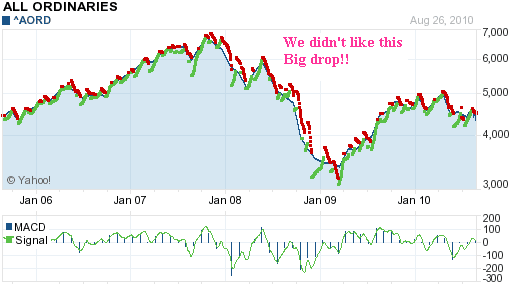
If you watch the financial news you'll hear that on Monday 24 May 2010, everything was rising again and tv newsreaders will say that the market rose by ..4% for example.BUT IT ROSE from its worst low since july 2009!
at 4330 it's still nowhere near its most recent high ..over 7000 points in Nov 2007.Its like facing a set of stairs. there is still a long way to the top and it might take 18 months to 2 years IF there are no more taxes, wars, drought, political unrest, volcanoes, major disease etc...
There will always be some companies rising when others fail but you need to do a lot of research, and then have some luck.
you could help yourself by watching the Price sensitive announcements (PSA)on the home page of the asx. www.asx.com.au and then chart them to see if you think they might attract predator buyers who will push the price up.. and remember this quote,
The Best of Times -- the Worst of Times
In 1859, Charles Dickens wrote in 'A Tale of Two Cities':
"It was the best of times, it was the worst of times; it was the age of wisdom; it was the age of foolishness; it was the epoch of belief, it was the epoch of incredulity; it was the season of Light, it was the season of Darkness; it was the spring of hope, it was the winter of despair ..."
be cautious, be careful and judge wisely.
FNT Frontier resources is a gold miner in New Guinea, therefore not concerned about the Aussie Govt's proposed 40% resource tax. They claim they have had some good results. Yesterday they had a Price sensitive announcement and were at .075 when I bought some. Worth buying a small parcel,under ten cents and promising..
Remember we are not financial advisors.. Sampson management Services (SMS) educate and inform only...We are Risk Asset Management Consultants- we teach you about risk and how to measure that risk according to the international standards on Quality, Environment, OHS, and Risk management in an integrated approach. Ref standards:AS/NZS/ISO 9001, AS/NZS/ISO 14001, AS/NZS/ISO 4804, AS/NZS/ISO 4360.
at 4330 it's still nowhere near its most recent high ..over 7000 points in Nov 2007.Its like facing a set of stairs. there is still a long way to the top and it might take 18 months to 2 years IF there are no more taxes, wars, drought, political unrest, volcanoes, major disease etc...
There will always be some companies rising when others fail but you need to do a lot of research, and then have some luck.
you could help yourself by watching the Price sensitive announcements (PSA)on the home page of the asx. www.asx.com.au and then chart them to see if you think they might attract predator buyers who will push the price up.. and remember this quote,
The Best of Times -- the Worst of Times
In 1859, Charles Dickens wrote in 'A Tale of Two Cities':
"It was the best of times, it was the worst of times; it was the age of wisdom; it was the age of foolishness; it was the epoch of belief, it was the epoch of incredulity; it was the season of Light, it was the season of Darkness; it was the spring of hope, it was the winter of despair ..."
be cautious, be careful and judge wisely.
FNT Frontier resources is a gold miner in New Guinea, therefore not concerned about the Aussie Govt's proposed 40% resource tax. They claim they have had some good results. Yesterday they had a Price sensitive announcement and were at .075 when I bought some. Worth buying a small parcel,under ten cents and promising..
Remember we are not financial advisors.. Sampson management Services (SMS) educate and inform only...We are Risk Asset Management Consultants- we teach you about risk and how to measure that risk according to the international standards on Quality, Environment, OHS, and Risk management in an integrated approach. Ref standards:AS/NZS/ISO 9001, AS/NZS/ISO 14001, AS/NZS/ISO 4804, AS/NZS/ISO 4360.
Friday, February 13, 2009
free aussie stock tip by Megamoneybox
Free Aussie stock tips by Megamoneybox
Aby.ax (ADITYA FPO [ABY]) was as high as $3.00 last year, and I made 17.4% profit on sale of stock. After the stock crash it dropped to just 11 cents, then rose to 16 and now 14 cents.
This company mines copper and paid a dividend last year of 10 cents, when it was at 2.34.
I made 5 cents profit a share this week, and I am confident it will come back to at least a dollar. Check it out on the www.asx.com.au and read the announcements.
FMS- was flinders diamonds.. rising too. Check it's history on asx.
FMG Fortesque metals went down to 1.61 , but now around 2.47. Was up around $8.00 last year..
This is a time of opportunity for those who aren't greedy, and who do not risk more than they can afford to lose. DON'T BORROW TO INVEST. DON'T USE A MARGIN LOAN.
Remember we are not financial advisors..
Sampson management Services (SMS) educate and inform only...
We are Asset Management Consultants- we teach you about risk and how to measure that risk according to the international standards on Quality, Environment, OHS, and Risk management in an integrated approach. Ref standards:
AS/NZS/ISO 9001, AS/NZS/ISO 14001, AS/NZS/ISO 4804, AS/NZS/ISO 4360.
Subscribe to:
Posts (Atom)