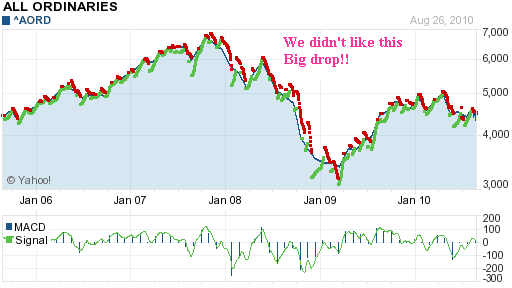
We've just had 8 weeks of choppy trading, so it's over to Marcus Padley to be entertained while we lick our wounds and
wonder if we ever really knew anything at all. Marcus is so funny and so
true.
Here's one of his earlier posts.

You need to learn to sell. 'The horror!'
Photo: Andrew De La Rue
We're in the middle of teaching SMSF newbies about ''timing''. This week we're going to address how to do it yourself.
When you talk about ''timing'', most investors, especially
conservative, pension-phase and long-term investors looking for a return
think ''timing'' means trading and trading has an image problem.
They think it means a ''short-term'' soul-sucking,
life-wasting activity for manic obsessives with sunken eyes, pale
complexions and McDonald's mayonnaise dripped down the front of their
T-shirts.
And, truth be known, even the less conservative investors,
people in the accumulation phase, in their 40s and 50s, people who are
still working and have a higher risk profile don't want to trade either.
Not because they have some philosophical objection but
because they are busy, have jobs, have kids and don't want to spend the
evenings or weekends looking at a computer screen again.
In most cases they have also tried their hand at trading
already and while they may have had the occasional success, it was a bit
of an insult to their intelligence, their household budget, their
school fees and their mortgage responsibility to pretend it was anything
more than a rather irresponsible if not stupid gamble that put far more
money at risk than the odds warranted, just because it was called
''investment'' instead of betting. Agree.
Trading, actually trading on charts with all the technical
education and trading skills you will need, can't be done part-time and
other than those with an intellectual interest few want to do it
full-time. Which leaves the average SMSF investor in a bit of a
quandary.
The GFC taught you that ''set and forget'' is dead and you
accept that, but you don't really want to trade, don't have time to
trade and are not prepared to learn how to trade.
So what do you do? The answer is this, ''Trading Lite''. This is the art of timing stocks for investors.
As an investor you basically want to keep doing what you're
doing, buying stocks for the long term with the intention of holding
them forever, but you want to avoid two things: (1) getting a stock
completely wrong a la Babcock & Brown and ABC Learning, or (2)
avoiding a GFC-style ''market'' event.
Sounds simple, but despite your best intentions you will
absolutely not be able to avoid either of these events until you change
the habit of a lifetime and learn to do something you are particularly
useless at. To sell. The horror!
The sharemarket is not about buying and never selling and it
is arrogance in the extreme to assume that you can make an assessment of
a company on the current incomplete and ever-changing information and
get that stock right forever after.
You are bound to get it wrong and denying that by never
selling is unintelligent. Of course things change and if some old Warren
Buffett misquotes and your pride and arrogance prevent you from
changing any decision you deserve to get caught. So step one is to
accept that you are not that smart, will get some things wrong and will
occasionally sell.
The final step is to work out when you sell. My advice on
this is the same, whether you are worrying about a particular stock or
the whole market. Do it on a stock-by-stock basis.
On your SMSF equity spreadsheet you have a column that shows
how far the stock is up or down since you bought it. Now add a column
called ''HIGH''. Every day or week or whenever you open the spreadsheet,
look up the highest price the stock has hit since the last time you
looked. Type it in.
Unless it hits a new high you leave it. In the next column
log how far the current price has fallen from that high. Put a
conditional format on that cell that turns the cell red if the fall is
more than 10 per cent.
If you open your spreadsheet and there aren't any red cells,
go back to your life. If a cell turns red, ask why. One red cell for one
week means you may have got a stock wrong, one red cell for a few weeks
means you have got a stock wrong and lots of red cells for more than
one week means you've got the market wrong.
Red cells that last more than a week mean you are ''constipated''. See how long you can ignore them.
Marcus Padley is a stockbroker and the author of sharemarket newsletter Marcus Today.